
 |
| Massachusetts - a place to be |
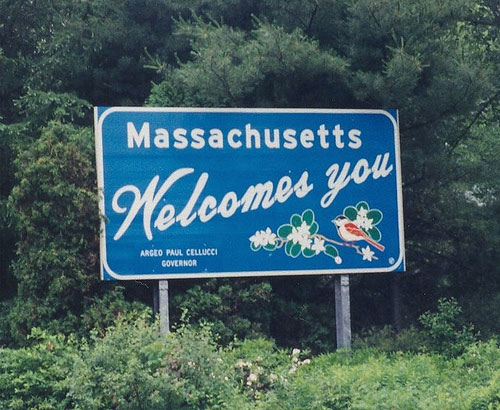
The Commonwealth of Massachusetts is a state in the New England region of the northeastern United States of America. It is bordered by Rhode Island and Connecticut to the south, New York to the west, and Vermont and New Hampshire to the north; at its east lies the Atlantic Ocean. As of the 2010 Census, the population of Massachusetts was 6,547,629. The state features two separate metropolitan areas — the eastern Boston metropolitan area and the western Springfield metropolitan area. Approximately two thirds of the state's population lives in Greater Boston, most of which is either urban or suburban. Western Massachusetts features one urban area — the Knowledge Corridor along the Connecticut River — and a mix of college towns and rural areas. Massachusetts is the most populous of the six New England states, the third most densely populated state in the United States, and also has the US's sixth highest GDP per capita.
 Massachusetts played a significant historical, cultural, and commercial role in American history. Plymouth was the second permanent English settlement in North America, and Puritans settling Massachusetts in the 1630s dominated New England for many years. Harvard University, founded in 1636, is the oldest institution of higher learning in the United States. In 1692, the towns surrounding Salem experienced one of America's most infamous cases of mass hysteria, the Salem Witch Trials. In the eighteenth century, the Protestant First Great Awakening, which swept the Atlantic world, originated from the pulpit of Northampton, Massachusetts preacher Jonathan Edwards. In the late 18th century, Boston became known as the "Cradle of Liberty" for the agitation there that led to the American Revolution and the independence of the United States from Great Britain. In 1777, General Henry Knox founded the Springfield Armory, which during the Industrial Revolution catalyzed numerous important technological advances, including interchangeable parts. In 1786, Shays' Rebellion, a populist revolt by Western Massachusetts farmers, led directly to the United States Constitutional Convention. Before the American Civil War, Massachusetts was a center for the temperance, transcendentalist, and abolitionist movements. In 1837, Mount Holyoke College, the United States' first college for women, was opened in the Connecticut River Valley town of South Hadley. In the late nineteenth century, the (now) Olympic sports of basketball and volleyball were invented in the Western Massachusetts cities of Springfield and Holyoke, respectively. In 2004, Massachusetts became the first U.S. state to legally recognize same-sex marriage. The state has contributed many prominent politicians to national service, including members of the Adams family and of the Kennedy family.
Originally dependent on fishing, agriculture, and trade, Massachusetts was transformed into a manufacturing center during the Industrial Revolution. During the 20th century, the state's economy shifted from manufacturing to services. In the 21st century, Massachusetts is a leader in higher education, health care technology, high technology, financial services, cannabis law reform, universal healthcare, and same-sex marriage.
What does Massachusetts mean? Massachusetts comes from the language of the Algonquian Indians of the Massachusetts Bay area - translated roughly as: at or about the great hill. Possible interpretations of the exact origin of the word Massachusetts:
INDIAN WORD:
|
TRANSLATION:
| |
messatossec
|
great hills mouth
| |
mess or mass
|
great
| |
atsco, as chu, or wad chu
|
hill
| |
sec, sac or saco
|
mouth
| |
massawachusett
|
great mountain place
| |
massa
|
great
| |
wachusett
|
mountain place
| |
moswetuset
|
Indian arrowhead*
|
Cities, Towns and Counties
There are 50 cities and 301 towns in Massachusetts, grouped into 14 counties. The fourteen counties, moving roughly from west to east, are Berkshire, Franklin, Hampshire, Hampden, Worcester, Middlesex, Essex, Suffolk, Norfolk, Bristol, Plymouth, Barnstable, Dukes, and Nantucket. Eleven communities which call themselves "towns" are, by law, cities since they have traded the town meeting form of government for a mayor-council or manager-council form.
Boston is the state capital and largest city in Massachusetts. The population of the city proper is 609,023,and Greater Boston, with a population of 4,522,858, is the 10th largest metropolitan area in the nation. Other cities with a population over 100,000 include Worcester, Springfield, Lowell, and Cambridge. Plymouth is the largest municipality in the state by land area.
Massachusetts, along with the five other New England states, features the local governmental structure known as the New England town. In this structure, incorporated towns—as opposed to townships or counties—hold many of the responsibilities and powers of local government. Some of the county governments were abolished by the commonwealth in 1997, and elect only a sheriff and registrar of deed who are part of the state government. Others have been reorganized, and a few still retain county councils.
Geography
Geography
Massachusetts is the 7th smallest state in the United States. It is located in the New England region of the northeastern United States, and has an area of 10,555 square miles (27,340 km2). Several large bays distinctly shape its coast. Boston is the largest city, at the inmost point of Massachusetts Bay, the mouth of the Charles River, the longest river entirely within Massachusetts. The state extends from the mountains of the Appalachian system in the west to the sandy beaches and rocky shorelines of the Atlantic coast.
The National Park Service administers a number of natural and historical sites in Massachusetts. Along with twelve national historic sites, areas, and corridors, the National Park Service also manages the Cape Cod National Seashore and the Boston Harbor Islands National Recreation Area. In addition, the Massachusetts Department of Conservation and Recreation maintains a number of parks, trails, and beaches throughout the commonwealth.
Ecology
The primary biome of inland Massachusetts is temperate deciduous forest. Although much of the state had been cleared for agriculture, leaving only traces of old growth forest in isolated pockets, secondary growth has regenerated in many rural areas as farms have been abandoned. Currently, forests cover around 62% of Massachusetts. The areas most affected by human development include the Greater Boston area in the east, the smaller Springfield metropolitan area in the west, and the largely agricultural Pioneer Valley. Animals that have become locally extinct over the past few centuries include gray wolves, elk, wolverines, and mountain lions.

A number of species are doing well, despite, and in some cases because of the increased urbanization of the commonwealth. Peregrine falcons utilize office towers in larger cities as nesting areas, and the population of coyotes, whose diet may include garbage and roadkill, has been increasing in recent decades.White-tailed deer, raccoon, wild turkeys and eastern gray squirrels are also found throughout Massachusetts. In more rural areas in the western part of the state, larger mammals such as moose and black bears have returned, largely due to reforestation following the regional decline in agriculture.
Massachusetts is located along the Atlantic Flyway, a major route for migratory waterfowl along the Atlantic coast. Lakes in central Massachusetts provide habitat for the common loon, while a significant population of long-tailed ducks winter off Nantucket. Small offshore islands and beaches are home to roseate terns and are important breeding areas for the locally threatened piping plover. Protected areas such as the Monomoy National Wildlife Refuge provide critical breeding habitat for shorebirds and a variety of marine wildlife including a large population of gray seals.
Freshwater fish species in the commonwealth include bass, carp, catfish, and trout, while saltwater species such as Atlantic cod, haddock and American lobster populate offshore waters. Other marine species include Harbor seals, the endangered North Atlantic right whales, as well as humpback whales, fin whales, minke whales and Atlantic white-sided dolphins.

holy mother of god!
ReplyDeletethat's the most awesome blog i've ever seen!
High five bro!
ReplyDeleteThis comment has been removed by the author.
ReplyDeleteHello Oleksandr,
ReplyDeleteYou have done a great job. Maybe this work took hours of your time. Your blog is nice and pictures are colourful. There are no disadvantages.
Best wishes,
Volodymyr Petrivsky 11-A
Thak you about the information
ReplyDeleteyou have done a great job!
I'm sure that the information you wrote is really very interesing but i made myself read only first chapter. it is too big as for me. But i really liked those what i really read. Thank's a lot.
ReplyDelete